




Available Colors: Red
Available Sizes:
Classic
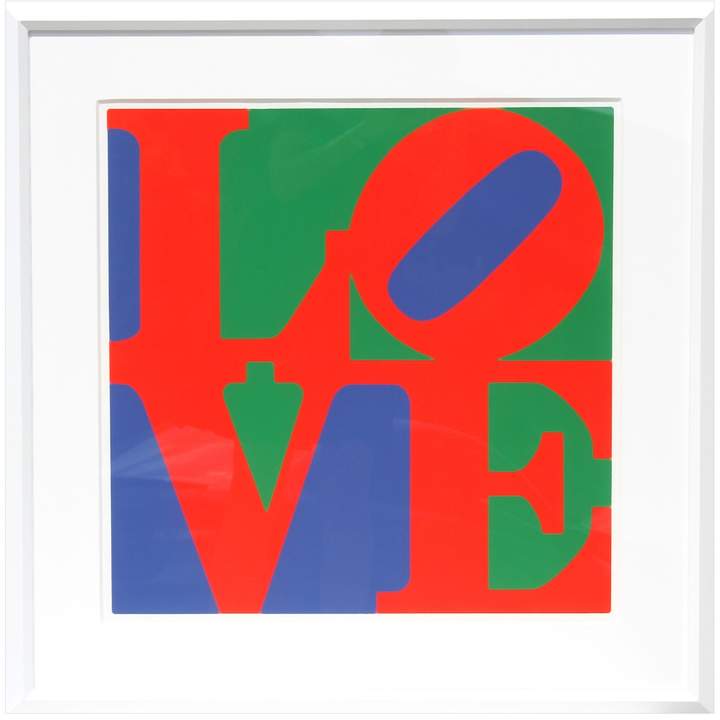
Love Serigraph: *Serigraph *Year: circa 1996 Robert Indiana, American
(1928 - ). There have been many American SIGN painters, but there never
were any American sign PAINTERS." This exercise in emphasis sums up
Robert Indiana's position in the world of contemporary art. He has taken
the everyday symbols of roadside America and made them into brilliantly
colored geometric pop art. In his work he has been an ironic
commentator on the American scene. Both his graphics and his paintings
have made cultural statements on life and, during the rebellious 1960s,
pointed political statements as well. Born Robert Clark in New Castle,
Indiana, in 1928, he adopted the name of his native state as a
pseudonymous surname early in his career. During his typically
Midwestern boyhood, highway signs had a symbolic importance for him. His
father worked for Phillips 66 gas and, when he left his wife and son,
he did so down Route #66. And the diner which his mother subsequently
operated had the familiar "EAT" sign looming overhead. Indiana studied
first at the Herron School of Art in Indianapolis and then at the
Munson-Williams-Proctor Institute in Utica, New York. From there he went
to the School of the Art Institute of Chicago where he received a
degree in 1953 and won a traveling fellowship to Europe. In 1954, he
attended Edinburgh University and Edinburgh College of Art in Scotland.
Back in America, Indiana settled in the historic Coentes Slip area on
the New York waterfront in 1956 and showed his first hard-edged
paintings the following year. From the start he worked with bold,
contrasting, sometimes clashing, colors that mirror familiar signs along
the highways. A moralist at heart and an admirer of Longfellow, Whitman
and Melville, Indiana often wryly prods his viewers. In a billboard4ike
triptych dedicated to Melville, for example, he reminds them of
Manhattan's past and suggests they walk around the island-city. He also
feels a strong kinship with such earlier precisionist painters as
Charles Demuth and showed his admiration in The Demuth American Dream
No.5 (1963, Art Gallery of Ontario, Toronto). Although painted in
Indiana's own idiom, it was clearly inspired by Demuth's well-known I
Saw the Figure 5 in Gold (1928, Metropolitan Museum of Art). The
American dream has been a recurring theme in Indiana's work, and he has
used it to both celebrate and criticize the national way of life. In the
midst of all the gaudy, star-spangled color of The American Dream #J
(1961, Museum of Modern Art), for instance, he highlights the words
"Take All" and "Tilt" as reminders both of Americans' materialism and of
the tendency of some to cheat, as they do on pinball machines. In his
paintings and constructions he has given new meaning to such basic words
as "Eat", "Die" and "Love" . Using them in bold block letters in vivid
colors, he has enticed his viewers to look at the commonplace from a new
perspective. One indication of his success was the appearance of his
immensely popular multi-colored "Love" on a United States postage stamp
in 1973.

No comments:
Post a Comment